
- Road and rail tunnels are enclosed, high-consequence environments — smoke, water ingress, and vibration are constants, and any network downtime during an incident directly affects driver and passenger safety
- This project covers tunnel infrastructure where continuous surveillance, PoE-powered field devices, and dependable communications had to be engineered specifically for that enclosed setting, not adapted from a typical outdoor rollout
Case Studies
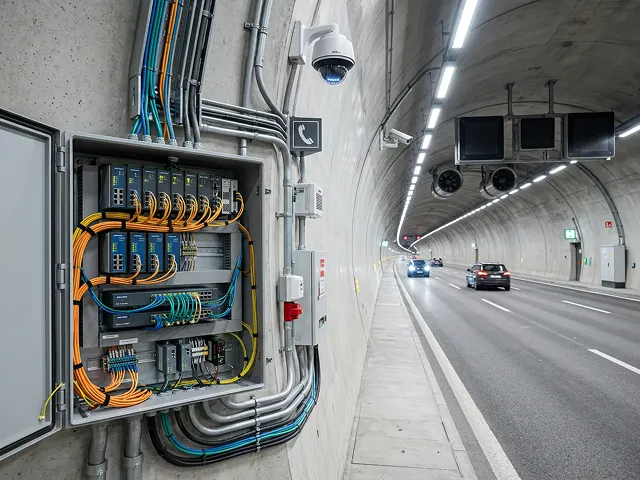
Tunnel Safety Network Enclosure
26 Jun 2026Industrial networking for tunnel infrastructure where surveillance, PoE, and reliable field communication are critical.


 Overview
 Challenges
The main challenges were
- Tunnels compress every networking challenge into a confined space: cameras
- control equipment installed along the bore have almost no room for oversized cabinets
- ventilation is limited so heat has to be managed passively
- because the tunnel itself restricts visibility and escape routes
- a dropped camera feed or comms link during an incident has an outsized impact on response time
 Objectives
The system needed to
- Provide robust
- continuous communications for tunnel monitoring and surveillance equipment; power PoE field devices without running separate power along the bore; and keep the network resilient enough that a single fault doesn't take out visibility across an entire tunnel section
 Solution Delivered
The solution included
- The tunnel was fitted with industrial PoE and fiber switching housed in compact, enclosure-rated cabinets suited to the confined tunnel cross-section, giving cameras and other field devices both power and network connectivity from a single cable run rather than separate power and data lines
- Fiber backbone links connected switching points along the tunnel length back to the surveillance and control system — chosen specifically because fiber tolerates the electrical noise and long, enclosed cable runs a tunnel produces far better than copper
- The switching architecture was also configured for fast link recovery, so if one segment of the tunnel network is disrupted, monitoring coverage on either side of the fault keeps operating rather than the whole tunnel losing visibility at once
Conclusion
Tunnel infrastructure is one of the clearest cases for purpose-built industrial networking: safety in an enclosed environment depends entirely on communications that keep working under conditions — heat, vibration, restricted space — that would degrade standard equipment.