
- A large solar farm made up of 32 photovoltaic power generation plants spread across a wide area needed a network infrastructure resilient enough to run security systems and monitor every facility continuously
- while surviving strong sunlight
- high temperatures
- oxidation
- electromagnetic interference
- electrical surges — conditions that are constant
- not occasional
- at a site this size
Case Studies
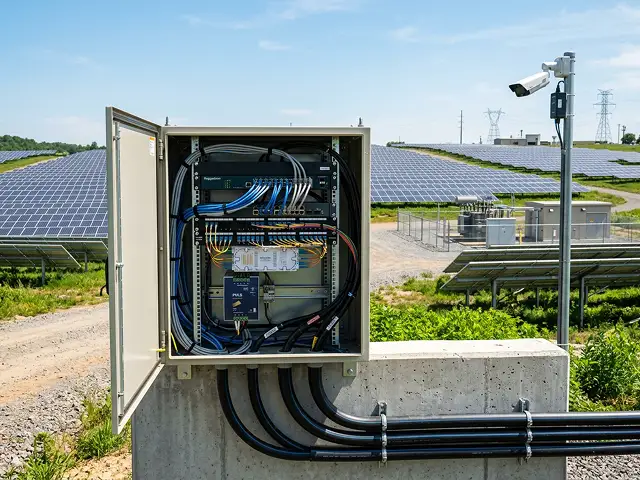
High-Speed Solar Farm Surveillance Backbone
26 Jun 2026Industrial fiber and PoE switching for real-time surveillance across a large, harsh-environment solar power farm.


 Overview
 Challenges
The main challenges were
- A distributed solar farm spanning 32 plants needs long-distance connectivity between sites, real-time surveillance data moving reliably across that distance, PoE power for IP cameras and access-control devices without running separate power lines, redundant network paths, and industrial-grade hardware that can survive years in outdoor cabinets
- Because security and surveillance coverage depend entirely on the communication backbone, fast network recovery after any fault is just as important as raw connectivity
 Objectives
The system needed to
- Build a high-speed fiber backbone connecting all 32 plants for surveillance traffic
- provide PoE connectivity at intermediate cross-connection points
- power field devices without adding separate power supplies
- improve overall network reliability
- reduce the performance degradation that harsh environmental exposure causes over time
 Solution Delivered
The solution included
- LSolution Delivered Layer 3 10G fiber and Gigabit stackable managed switches were deployed at the farm's main cross-connection points, giving the backbone enough throughput and reach to carry surveillance traffic across the full 32-plant footprint on fiber rather than copper — which also sidesteps the EMI issues a site full of power-conversion equipment would otherwise create
- At intermediate cross-connections closer to the cameras and access-control devices, industrial 802.3at PoE and fiber Ethernet switches delivered both power and data over a single run, removing the need for separate power infrastructure at every camera location
- The switching architecture was configured with ring-based redundancy so that if any single link or switch failed, network traffic rerouted automatically in under 10 milliseconds — fast enough that surveillance coverage didn't blink even during a fault
- Dedicated industrial DIN-rail power supplies backed each switch to keep the whole backbone running independent of any single power source
Conclusion
This story is a strong renewable-energy infrastructure case because it is not just about solar generation; it is about securing and operating a large power asset. The application shows why industrial fiber, PoE, redundancy, and harsh-environment switching matter in real solar-farm deployments.