
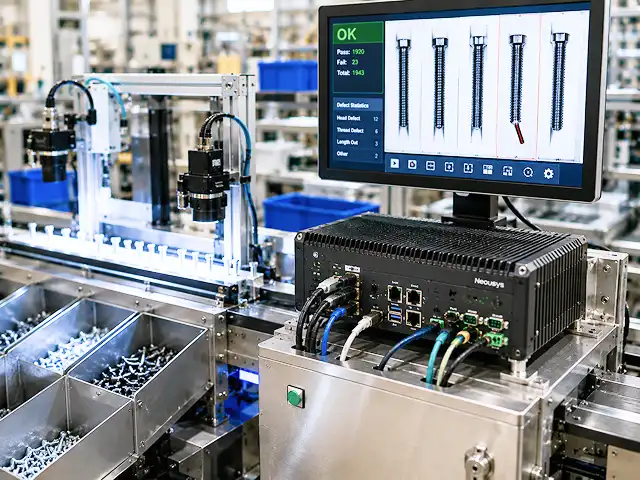
- In fastener sorting, machines have to process hundreds of screws, bolts, and pins per minute while detecting small deviations in size, shape, and defects
- Industrial cameras with high-resolution sensors, telecentric optics, and controlled illumination provide distortion-free imaging, while an industrial computer provides the real-time processing backbone the inspection system runs on
Case Studies
Fastener Sorting With Edge Vision
26 Jun 2026Rugged fanless industrial computer for high-speed optical inspection of screws, bolts, pins, and other fasteners.


 Overview
 Challenges
The main challenges were
- A factory machine-vision computer in this setting has to survive constant vibration from conveyors and actuators, occasional shock, metallic dust, and temperature fluctuation
- It also has to handle high-bandwidth camera traffic through interfaces like GigE Vision or USB3 Vision, while providing deterministic I/O and industrial communication for reject mechanisms, PLCs, and sorting actuators — all without missing a fastener at line speed
 Objectives
The system needed to
- Maintain real-time inspection performance
- classify every fastener without interruption
- connect industrial cameras directly
- support PLC/sorting-actuator interaction
- deliver long-term reliable operation in a harsh factory environment
 Solution Delivered
The solution included
- A compact fanless industrial computer was deployed as the inspection controller, acquiring image data from high-resolution industrial cameras and processing inspection logic in real time as each fastener passed the camera
- It connected to the surrounding factory control equipment through Ethernet, USB, isolated digital I/O, and serial communication — the isolated digital I/O specifically for triggering the reject mechanism the instant a defective part was identified, so sorting happened in the same motion as inspection rather than as a separate downstream step
- The rugged, fanless construction meant dust, shock, vibration, and temperature swings on the shop floor didn't degrade the inspection system's uptime the way they would a standard PC
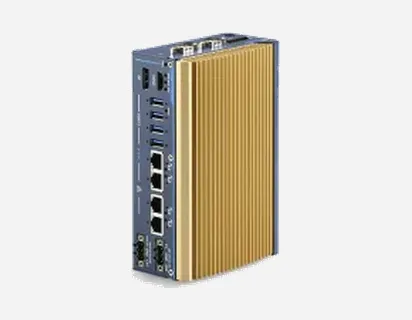
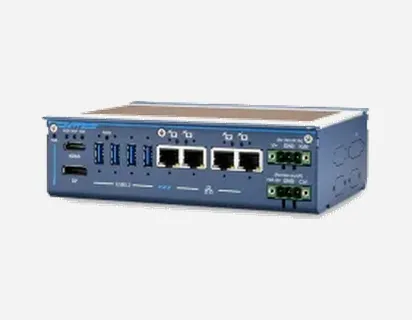
Products referenced in the source material include
Conclusion
This is a strong Manufacturing story because it is directly linked to quality, throughput, and uptime. It shows how rugged edge computing enables high-speed optical sorting machines to detect small defects consistently while surviving real factory conditions.